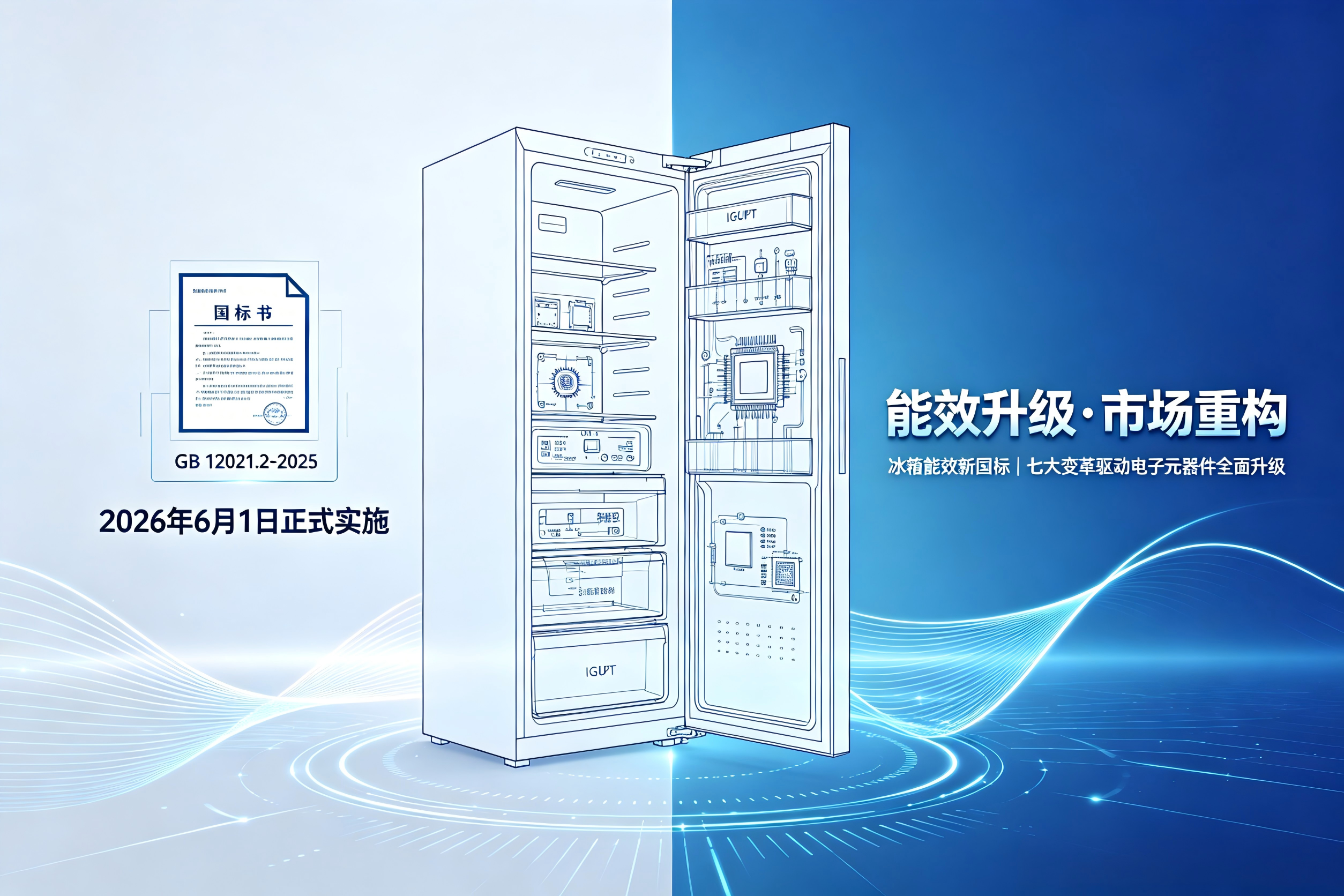
The implementation of the new national energy efficiency standard GB 12021.2-2025 has ushered in a wave of technological upgrading and market restructuring for electronic components.
2026.06.11
16 次

GB12021.2-2025

《Maximum allowable energy consumption and energy efficiency grades for household refrigerators》


深圳市钧敏科技有限公司

New National Energy Efficiency Standard

The new national standard GB 12021.2-2025, dubbed the strictest refrigerator energy efficiency standard ever, came into official force on June 1, 2026. Featuring expanded scope of application, drastically tightened energy efficiency indicators, newly added assessment of volume utilization rate and revised requirements for smart grid responsiveness, the seven major revisions of this standard have reshaped the competition landscape of the refrigerator industry and put forward brand-new technical requirements for upstream electronic components. An upgrade competition centered on high efficiency, precise control and intelligence among components has quietly kicked off.


01

Core Changes of the New National Standard


Comprehensive Upgrade from Simple Power Saving to Ultimate Energy Efficiency Plus Intelligent Experience


The revision of this new national standard completely breaks the boundaries of the traditional energy efficiency evaluation system. Each revision targets the pain points of the industry and clarifies the upgrading roadmap for electronic components.


ON

Historic expansion of the scope of application


Semiconductor cooling appliances with a volume of ≤60 L (such as hotel mini-fridges and vehicle-mounted small refrigerators) have been included in the mandatory standard for the first time. These products long remained outside regulatory oversight due to their compact size and low power consumption. They are now required to meet the same energy efficiency criteria as large-sized refrigerators, unlocking brand-new market opportunities for semiconductor temperature control-related electronic components.


2

The access threshold for energy efficiency has been significantly raised.


The maximum permissible power consumption value has been tightened from 70% of the reference power consumption under the old standard down to 40%, meaning the baseline energy consumption of products is essentially halved. This imposes stringent ultra-high requirements on loss control for components used in power management and power conversion circuits.


3

The indicators for energy efficiency grades have nearly doubled.

The comprehensive energy efficiency index for Grade 1 energy efficiency shall be no more than 20%, compared with the upper limit of 50% specified in the old standard. The threshold for Grade 5 energy efficiency has also been raised to no more than 40%, up from the previous 90%. Even the minimum energy efficiency requirement now exceeds the Grade 1 standard of the old version, forcing complete phasing-out of low-efficiency component solutions by complete appliance manufacturers.

4

New assessment indicator of "volume utilization rate" is added

For the first time, the standard incorporates the actual usable volume of refrigerators into the energy efficiency evaluation system and mandates manufacturers to optimize internal structural design. As a result, core components including compressors and control boards need to evolve toward miniaturization and higher integration, driving the miniaturization upgrade of power devices and sensors.

5

Introduction of the correction mechanism for smart grid responsiveness

Refrigerators equipped with smart grid responsiveness are eligible for bonus points in energy efficiency grading. This policy incentivizes product adaptation to peak-valley electricity price regulation and intelligent load control, generating incremental demand for MCUs, communication modules and intelligent power management chips.

6

Testing methods aligned with international standards

Adopting the IEC 62552-3:2020 standard, the power consumption of automatic ice-making function is excluded from the final calculation result. This drives manufacturers to optimize the independent control of ice-making systems, with low-power relays and high-precision temperature control sensors serving as critical supporting components.

7

Clear transitional period policies

Products manufactured or imported prior to June 1, 2026, may remain on sale until June 1, 2028. Complete appliance manufacturers are speeding up inventory clearance while launching component selection and verification for new-generation products, marking the full launch of the transition window across the entire supply chain.


02

Four Major Upgrade Directions Unfold for Electronic Components, with These Segments Taking the Lead in Benefiting


The stringent requirements of the new national standard are driving refrigerator manufacturers to systematically replace upstream electronic components, with urgent upgrading demands emerging in four core sectors:


1

High-Efficiency Power Semiconductors: The "Heart" Driving Energy Efficiency Improvement


Power semiconductor losses directly determine the energy efficiency level of refrigerators, ranging from variable-frequency compressor drives to power conversion modules. Driven by the new national standard, low-loss and highly integrated power devices have become an indispensable requirement:


Core Devices for Variable-Frequency Drives

IGBTs and MOSFETs stand out as the preferred solutions for variable-frequency compressor drives thanks to their ultra-low conduction and switching losses. New-generation low-loss IGBTs (e.g., products adopting field-stop technology) can cut drive system losses by more than 30%, while delivering robust short-circuit withstand capability to ensure stable operation under extreme working conditions, directly enabling complete appliances to meet Grade 1 energy efficiency standards.


Power Management ICs

AC-DC PWM controllers integrating 700V power MOSFETs support wide input voltage range and multi-protection functions, drastically reducing standby power consumption and conversion losses to comply with the new standard's stringent limits on standby energy use. Meanwhile, DC-DC boost converters deliver precise power supply control for ice makers and intelligent loads, eliminating unnecessary energy waste.


2

High-Precision Temperature Control Sensors: The "Nerve Endings" Safeguarding the Bottom Line of Energy Efficiency


The new national standard imposes unprecedented requirements on the temperature control accuracy of refrigerators. Specifically, Grade 1 energy efficiency products must be equipped with multi-zone independent temperature control systems; the allowable temperature error is tightened from ±0.5°C to ±0.3°C, and the transient response deviation shall not exceed ±0.15°C:


• NTC thermistors and temperature sensors

High-precision, low-tolerance NTC thermistors serve as the core of temperature control systems. Combined with CBB capacitors featuring low dielectric loss to form a filter network, they effectively suppress signal interference and deliver accurate temperature sampling, furnishing reliable data support for dynamic defrosting and variable-frequency speed regulation of compressors.


• Intelligent defrosting control componentsDynamic defrosting strategies based on ambient temperature and humidity sensing are incorporated into energy efficiency calculations. Conventional timed defrosting relays are being phased out gradually. Intelligent relays with frost thickness prediction functions and humidity sensors are gaining rapid market penetration, capable of cutting the energy consumption proportion for defrosting by over 40%.


3

Intelligent Control and Connectivity Components: The "Brain" Unlocking Energy Efficiency Bonus Points


The correction mechanism of "smart grid responsiveness" introduced in the new national standard directly links the intelligent functions of refrigerators to their energy efficiency ratings, driving the upgrade of intelligent control components:


• Highly integrated MCUs and control chips

MCUs embedded with load prediction and peak-valley electricity price regulation algorithms enable precise scheduling of compressors and fans. Meanwhile, they can adapt to smart grid signals and provide algorithmic support for products to obtain bonus points in energy efficiency grading.


• Communication modules and power management unitsCombining communication modules such as Wi-Fi and Bluetooth with low-power power management units enables remote control and intelligent load response of refrigerators. While delivering smart user experience, it further cuts unnecessary energy consumption.


4

Miniaturized Passive Components: The "Capillaries" Catering to Volume Utilization Assessment

The mandatory requirements for volume utilization rate force complete machine manufacturers to optimize internal structures, generating incremental demand for miniaturized and highly reliable passive components:

• Miniaturized film capacitors and ceramic capacitors

Low-loss, compact-sized CBB capacitors and ceramic capacitors enable compact layout of temperature control circuits and power supply circuits while maintaining stable dielectric properties, without occupying the effective internal storage volume of refrigerators.

• Micro relays and connectors

Small-package, high-reliability relays and connectors meet the control requirements of miniaturized ice makers and auxiliary loads, reduce PCB board space occupation, and help manufacturers improve the volume utilization rate indicator.


03

Opportunities and Challenges Facing the Supply Chain


No.1

How Enterprises Seize the Dividends Brought by the New National Standard


With the full implementation of the new national standard, electronic component enterprises are embracing structural opportunities while confronted with dual challenges in technology and market:


机遇

Dual Drivers: Stock Replacement and Incremental Capacity Expansion

On the one hand, traditional low-efficiency components are being phased out, and the market penetration of high-precision, low-loss products will rise rapidly. On the other hand, the inclusion of semiconductor cooling appliances with a volume of ≤60 liters has unlocked a brand-new incremental market for components related to semiconductor temperature control. It is projected that by 2028, the market size of high-precision sensors and high-efficiency power devices used in refrigerators will grow by more than 35%.

挑战

Shorter Technical Verification Cycle and Mounting Cost Pressures

High R&D and production costs make cost optimization while meeting performance requirements a key factor in enterprise competition.


For component manufacturers, grasping the core requirements of the new national standard and launching targeted matching solutions is critical to capturing market share. For instance, developing low-power temperature control sensors for semiconductor cooling appliances, highly integrated IGBT modules for inverter refrigerators, and low-power communication and control solutions for smart grid responsiveness will serve as breakthrough points to penetrate the market.


The new national standard is not merely an industrial reshuffle for the refrigerator sector, but also a catalyst for technological upgrading across the electronic components industry. Upgrades in every segmented track, ranging from high-efficiency power semiconductors and high-precision sensors to intelligent control chips and miniaturized passive components, are propelling the industry toward greater energy conservation, intelligence and efficiency. As the transition period draws near, the window for supply chain transition is rapidly closing. Only enterprises that make early arrangements for technological R&D and market verification can seize the initiative amid this wave of energy efficiency upgrading.


<<<  END >>>


电话联系丨18926468515

网址丨www.junmintech.cn