Stop blind replacement! SPI Flash compatibility is far from simple—these hidden pitfalls will definitely trip you up in mass production.
2026.04.23
5 次
Flash P25Q64SH PY25Q64HA P25Q32SH PY25Q32HB PY25Q128HA PY25Q80HB PY25Q16HB
Flash


存储

Flash


In hardware development and mass production, many engineers encounter a seemingly simple question:
Can SPI Flash chips from different brands be directly replaced with one another if they share the same capacity, package and pin definition?
The answer is usually unsatisfactory.
Numerous projects have suffered severe consequences from arbitrary SPI Flash replacement, leading to issues such as:
  • Failure to boot up

  • Abnormal read and write operations

  • Data loss

  • Occasional system crashes

These problems severely undermine mass production stability.
In fact, despite the high similarity in appearance and basic functions among SPI Flash devices, major subtle differences exist between manufacturers in terms oflow-level protocols,register configurations,and reliability specifications.
Such discrepancies may not surface during the prototype debugging phase, yet they will evolve into high-frequency failure risks once mass production begins.


01

Why do seemingly identical Flash chips cause malfunctions?


In engineering practice, the differences of SPI NOR Flash mainly lie in three key aspects.
  1. JEDEC ID and package only show superficial consistency

Most purchasers only focus on part numbers, such as:W25Q64GD25Q64P25Q64SH / PY25Q64HB
All of these feature the same capacity of 64Mbit.
However, engineers need to verify the actual critical parameters:
  • JEDEC ID

  • Package dimensions

  • Pinout definition

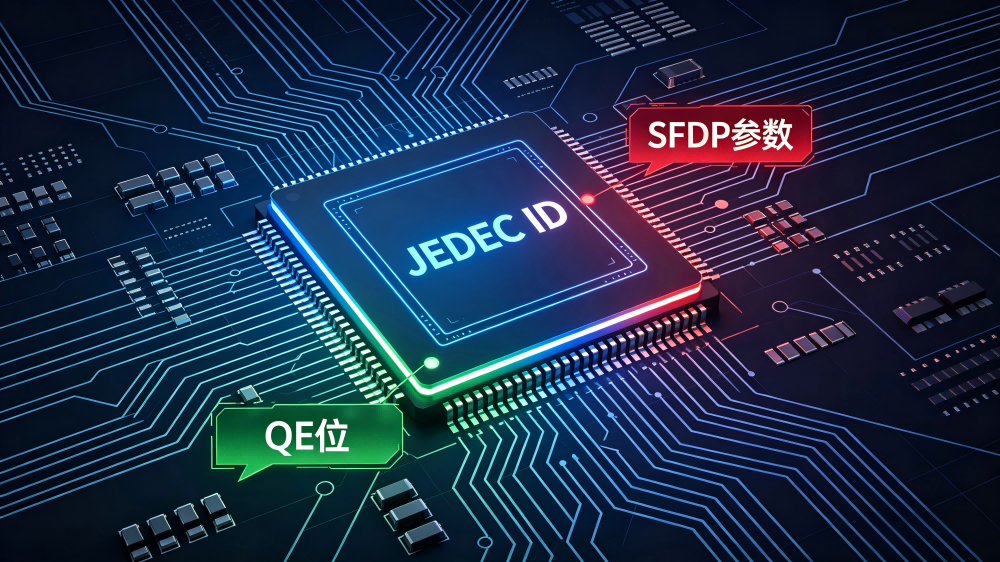
Even for Flash chips with the same storage capacity, manufacturers may adopt different designs in ID identification and package details.If the Bootloader is programmed to recognize only a fixed JEDEC ID, direct replacement will easily cause boot failure.


SPI Flash  >>>


2. Instruction sets look nearly identical, yet subtle details prove fatal

Most SPI Flash devices support Standard SPI, Dual SPI and Quad SPI, presenting a unified specification on the surface.
However, problems frequently stem from the Quad Enable (QE) bit.Flash chips from some manufacturers ship with QE=0 by default.If engineers enable Quad mode directly without configuring the corresponding register, read commands will fail completely.
This issue commonly occurs in the following scenarios:
  • SPI Flash cross-brand replacement

  • Supplier switching

  • MCU firmware upgrades

3. Huge discrepancies in reliability parameters

Most projects only focus on storage capacity and operating frequency, while ignoring critical specifications below:
  • P/E cycle endurance

  • Deep power-down current

  • Continuous read performance

  • Erase and programming time

Differences in these parameters directly determine product service life, standby power consumption and long-term operational reliability.
Certain Flash chips work stably in laboratory tests, but suffer from data corruption during mass production aging tests.


02

Two Most Common "Pitfalls" in Engineering Projects


Pitfall 1: Incorrect Voltage Selection

SPI Flash falls into two major voltage systems:
  • 3.3V

  • 1.8V

Failure to check the voltage specification during replacement will lead topower-up failure of the entire board.
This issue is extremely common during urgent material substitution.

Pitfall 2: Mismatched SFDP Parameters

Most modern MCUs automatically identify Flash parameters via the SFDP table.
If alternative components adopt different SFDP implementations,the following faults may occur:
  • Random read failures

  • Abnormal erase and write operations

  • Quad mode malfunction

Such problems are the hardest to troubleshoot.Instead of complete functional failure, they only trigger intermittent errors.


03

Flash Replacement Checklist for Engineers


 If you need to carry out Flash replacement, it is recommended to verify at least five key items:

  • Consistent Voltage

3.3V ↔ 3.3V
1.8V ↔ 1.8V

Package and Pin Definition

Verify compatibility of:
  • SOP8

  • WSON8

    and confirm identical pinout arrangement.

Command Set Compatibility

Confirm support for:
  • Standard SPI

  • Dual SPI

  • Quad SPI

    and check the QE bit configuration.

Performance Specifications

Key indicators to focus on:
  • Read frequency

  • P/E cycle endurance

  • Erase and programming time

Supply Capacity

For most projects, the core challenge is not technical limitation, but sudden stock shortage.
Stable long-term supply is often more critical than theoretical specifications.


04

Industry Trend:

Capacity upgrading has become a rigid demand.


As product functions continue to expand, the size of system firmware keeps increasing, UI resources grow richer, and OTA remote upgrades become widely adopted, driving a continuous rise in demand for Flash storage capacity. Traditional 16Mb/32Mb specifications are gradually being replaced by 64Mb, 128Mb and even higher-capacity models. Meanwhile, SPI Flash has evolved from a simple storage component into a core part that determines overall system stability.
In conclusion, SPI Flash chips are not universal interchangeable parts. Comprehensive compatibility verification must be completed before replacement to avoid penny wise and pound foolish, which may lead to R&D rework and massive losses in mass production.


 In-Stock SPI NOR Flash Models

P25Q32SH / PY25Q32HBP25Q64SH / PY25Q64HBPY25Q80HB / PY25Q16HBPY25Q128HA

Available Services:

  • Sample testing

  • Compatible replacement solutions

  • Mass production supply support

If you are looking for a reliable supply solution for SPI NOR Flash, feel free to contact us.


深圳市钧敏科技有限公司

电话丨18926468515

网址丨www.junmintech.cn

长按关注